Brief Report on Ethiopia's Crimes Against Eritrean civilians 1961-1991
Lessons Never to be Forgotten
Part II 1960s to 1974
In 1962 Emperor Haile Sellassie unilaterally dissolved the Eritrean parliament and annexed the country
We need the Land not the People,” declared the Ethiopian emperor at the first place
Because of this policy the Second Ethiopian Army division burned many villages and killed many the unarmed civilian population.
Phase 1 : Barbaric crimes committed by the Second Ethiopian Army division in the 1960s
Based on the Human Right Watch report (1991:44) the first large-scale abuses of human rights occurred during three army offensives in 1967. Here is a short list of atrocities that committed against civilians by the Second Ethiopian Army division
1965 at Merara, Hamassien province, and at Medeka, Keren province 67 men and 46 men respectively were killed by the Ethiopian soldiers.
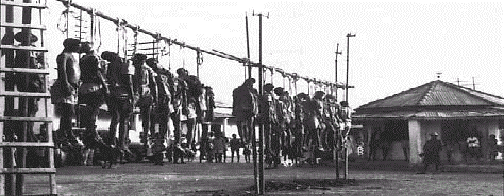
On 11 of February 1967 many villages were burnt down in Barka district by the Second Ethiopian Army division. According to reports from local community leaders, 402 civilian were killed, and about 60,000 cattle and camels slaughtered with machine guns and knives and burning alive. In addition 21 detainees, most of them teachers and government employees were summarily executed in Tessenei prison on February 12.
Following an attack launched by the Ethiopian army against the area where the Eritrean Liberation Front was operating, 28, 600 refugees crossed into Sudan in March 1967. (Kibreab, 1987:71).
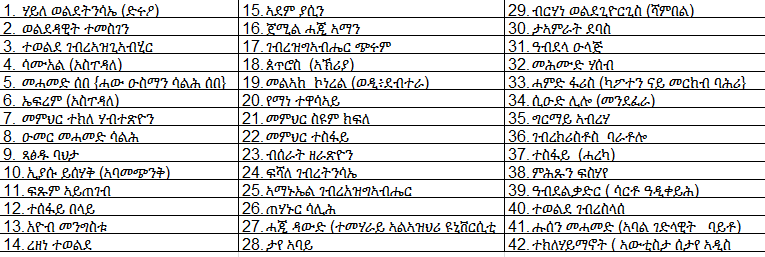
The February-March 1967 martyrs at the villages of Ad-Ebrihim, Ad-Kukui, Ad-Jemil, Ad-Omer, Ad-Saydna Hamid, Ad-Gherbet, Ad-Fedl, Ad-Habab, Emtrub, Mogoraib and others in Barka who were killed after the burning of 62 thriving villages and the machine-gunning of over 60,000 of their livestock. Renewed burning campaigns of that year killed many and displaced thousands after burning the villages of Halhal, Bab-Jengeren, Hamelmalo, Melebso,Felhit, Enchinaq, Hashishai, Fana, Wazintet, Qamchewa, Azreqet, Habero and many others put at 173 villages by some field researchers.
Between February and April in 1967, the Ethiopian soldiers burned 62 villages, including Mogoraib, Zamla, Ad Ibrahim, Gerset Gurgur, Adi Bera, Asir, Fori and Ad Habab. Furthermore, 402 civilians were killed, and about 60, 000 cattle and camels slaughtered with machine guns and knives and by burning them alive. This was reported from local community leaders.
Between 30 April and 8 May 1967, the Ethiopian army burnt 120 villages to the ground, with an estimated 10, 000 people killed and approximately 50,000 fleeing to more secure parts of the country, or into Sudan as refugees. Eritreans for Liberation in North America,( EFLNA, 1977:23.). Reporting on the military actions against civilians in the southern lowlands and districts surrounding the town of Keren in Senhit Province, an Ethiopian prisoner of war commented.
" It is true that whenever we were going to or coming from a battle, we used to burn many village s on the way, kill anyone in sight and take away whatever property we could put our hands on. For instance, I can recall, when we were engaged in a battle near Keren around December 1967, seeing many villages burnt such as Babjengen" , Halhal(cited in Eritrean People's Liberation Front, 1982: 72). Furthermore, according to the ELF (sep.1977) report an estimated number of 40,000 civilians were massacred during the six years of the armed struggle. Over 1,500 villages were given to flames, 3,000 forced-settlers were created
On 11 July in 1967 the villages of Eilet and Gumhot were burned, and 30 young men tied up and burned alive inside a house. Five other villages were burned over the following days, 51 people killed. 6, 000 domestic animals were killed. According to reports the soldiers singled out camels for slaughter, because they were vital for transport. Wolde Giorgis (1987:82) also cited those soldiers slaughtering cattle, eating what they wanted, and then leaving the rest to rot. He adds that sometimes soldiers would kill cattle just to get the livers.
In November 1967, almost all the villages of Senhit 174 in all were destroyed by soldiers from the Second Ethiopia Army Division . Some reliable sources reported atrocities included: Kuhul and Amadi: the army ordered the people to collect in one place, where they were bombed by air force planes
Asmat: the army opened fire on a wedding party, killing an unknown number
In 1967, over 40 men were slit on the neck in front of their children and wives at Misyam
The August 1967 wanton killings and burning of the villages of Ailet, Asus, Weqiro, Figret, ShebaH, Gedged, Gemhot, Metkel-Abet and many others.
The summer-autumn 1967 killings and burning in highland Eritrea and destroying wiping out whole villages and property in the Hazemo-Hazo valleys and plains, at Fishey-Merara, Deg’A, Arebet, Diyat, Timza’e, Mai Chada, Endazmach-Ogbit and other localities. These were followed by grisly massacres like the one at Misyam where the over 40 men were slit on the neck in front of their children and wives.
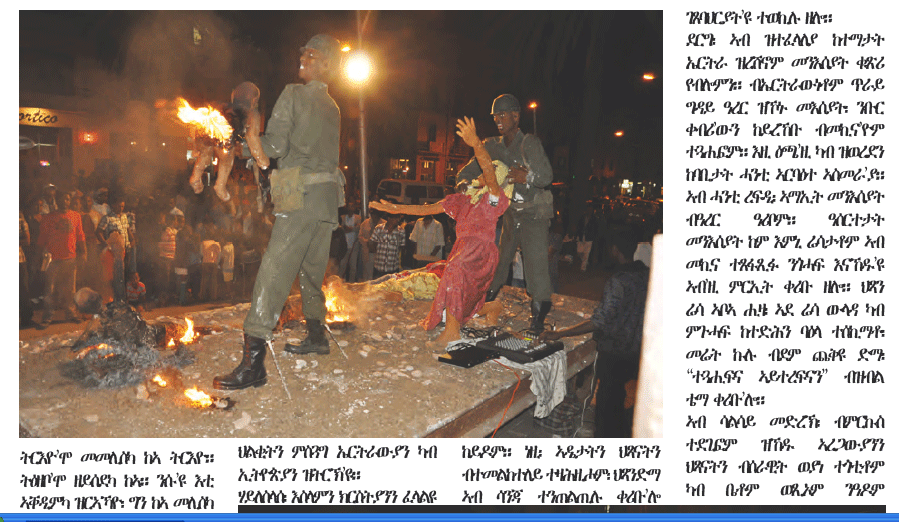
In 1969, marshal law was proclaimed, as armed resistance became stronger. Haile Selassie used to say that ‘We need the land but not the people'. Ethiopia first attacked the lowlands, and gradually the whole Eritrea was on fire, except the cities. In the lowlands, villages were burned to ashes and its inhabitants slaughtered, and some children were found sucking the breast of their dead mothers. He had problems governing Eritrea as a whole. (Cbaac, 2008)
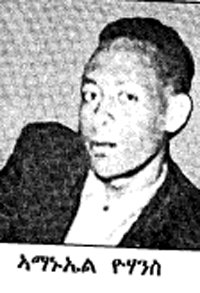
Despite the Ethiopia army killed many civilians from Arafali, Atshoma, Ona etc. and burnred their villages between 1967 and the early 1970s, Issays held secret talks with the CIA in order to eliminate the ELF which he achieved in 1981. Regarding his secret meeting with the CIA, Amar(2004) states that Wodi Giorg , who was at the meeting with Issays and Col. Mamuzer Copland on 2 Jun 1981ly 1970(note), had an interview with the local press in Addis which appeared in an Amharic newspaper called "Senay", volume 1 number 3 of February 1993. A short while later, Wodi Giorgio was shot dead in front of his Addis Ababa house in order to keep the meeting secret.
Phase II : Barbaric crimes committed by the Second Ethiopian Army division in the early 1970s
The civilians became victims of
the Ethiopian atrocities because of rivalry continuation between Idris
M.Adem and Sabbe which cause for the two years civil war in the early 1970s
In
March 1970 32 civilans were shot dead when the army burned Arafali village. 88 people were executed when the people of Atshoma refused army order to relocated in a protected village this was in March of 1970. as a result of this 700 refugees fled to
Sudan, mostly to the Tokar area along
the Red Sea coast.
The period from April
to July witnessed many atrocities as military
activities spread to eastern lowlands.
32 civilians were sho dead when the army
burned eastern lowlands.
88 people were
executed when the people of Atshoma, Arafali
village refused army orders to locate
in a protected village. Violence against
the civilian population increased towards
the end of the 1970s
In November, 112 people were killed in a mosque at Basadare. The people were collected in the mosque by soldiers who said they would be safe there from a planned air strike; the soldiers then opened fire.
The December 1970 massacre of 78 men in Wara, Hamassien and many other atrocities committed under the imperial regime of Haile Selassie.
This day in 1970: The Ona and Besikdira massacres by by Ahmed Raji [1 December 2015, source https://www.facebook.com/ahmed.raj]
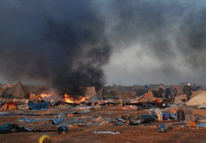
On the morning of November 30, 1970 (which also happened to be the Muslim holiday of Eid-al-Adha), Ethiopian troops entered the village of Besikdira, 15km north-east of Keren, rounded up the population and crammed them into a mosque. The soldiers were on a mission of revenge following the killing of an Ethiopian army general by Eritrean Liberation fighters the week before, and had already burned several villages in the area in the preceding days. The soldiers positioned their machine guns at the entrance to the mosque and on windows. They opened fire indiscriminately, killing 118 innocent civilians, including women and children.
(Despite the Ethiopian officers' attempts to separate the population by faith, people stuck together. After all, they were family. Hence, the victims included Muslims as well as Christians). However, Besikdira was only a prelude to a bigger massacre. On the morning of the following day, December 1, 1970, soldiers stationed in Keren descended on the nearby village of Ona and proceeded on a killing spree never seen before in Eritrea. Soon the the entire village was in flames. Those who were not burned in their huts, were gunned down as they attempted to flee. An estimated 700 villagers and their guests (there was a funeral in progress) died. My own memory of that day (I was in 2nd grade) is one of utter terror hearing the seemingly interminable sound of machine guns and of the slow-moving shower of soot and little pieces of charred straw that were scattered by winds over parts of Keren.
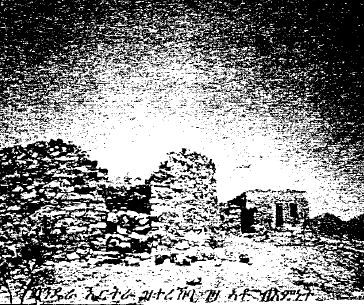
[The picture shows the ruins of the mosque in Besikdira, which still remains in the same state of ruin as a reminder of that terrible day. Photo is courtesy of Dr. Kiflemariam Hamde]
A Book Review. Paulos Tesfaldet (2013). በስግዲረዲንርቍርዲ. Besikdira and Its Children.
Författares Bokmaskin, Stockholm, 102pp. Written by By Kiflemariam Hamde, Umeå, Sweden
Besikdira and its children, በስግዲረዲንርቍርዲ is the latest Blin literary work, in the fiction genre, mainly based on historical, real events in Eritrea since 1960s. The book consists of 21 chapters opening up with a Preface and Acknowledgement. In this review, I find only point out the main story lines. The narrative is centred around, but not limited to, the massacre in the village of Besikdira, 15km east of Keren town. After burning seven villages the previous days, the uninvited Ethiopian army visited Besikdira in November 30, 1970 only to destroy it. The officer (ሻምበል) Teshome, and his Amharic-speaking troops, also including Eritrean-born Kumandos, posed two immediate questions to the people in Tigrigna (only 5 adults could speak it) as the people did not understand Amharic: (1) if the village is free from bandits (ሽፍታ, shifta)[i], in his own words bedbugs and fleas), and (2) if they were either Muslims or Christians. Mr Mender Beimnet, the village chief, and Mr Tesfu Almedom responded that they did not know of any bandits and that the people belonged to both Christianity and Islam. Upon learning that the people did not want to get separated along religious lines, the troops forced the inhabitants into the village Mosque and shot them down indiscriminately, killing 118[ii] civilians 11 of whom were pregnant mothers, 20 were children, and the rest were youngsters and adults[iii]. The author narrates in his fictional work about the details in the killing.
The next day, December 1, 1970 was the turn of Ona village, only 4-5 Kms north east of Keren, when the military forces headed by Colonel Welana massacred almost 800 civilians indiscriminately, and without any notice. There was no question that the people supported the liberation movement since 1962. The story starts off with the general political instability since the 1960s when the Eritrean Liberation Front (ELF) confronted Ethiopia’s domination after the latter had annexed Eritrea as its 14th Province, revoking the UN arranged Federation (1952-1961). As the ELF was active in the Western lowlands, Ethiopian atrocities increased heavily and the apex of that came in the fall of 1970 when the ELF ambushed and killed General Teshome Ergetu, head of the Second Military Division in October 1970. He was heading toward his new headquarters in Keren town to crash the ELF and the people, to ‘dry the sea in order to catch up the fish’, i.e., to target the civilians in order to weaken and consequently destroy the ELF. Those massacres are put in this context, and one man’s life was to be compensated for by around 1000 within less than 24 hours in Besikdira and Ona. Interestingly enough, the author accounts for how the atrocities became catalyst and intensified struggle for independence.
In his fictional description, the author exemplifies the events in a life of a nuclear[1]and extended family members, the inhabitants of Besikdira, its environs, the Sekwina district, the Senhit Province, events all over Eritrea, the fate of youngsters in their yearning for freedom, justice and equality, and finally, the inflicting cruelty of Ethiopian soldiers. The centre stage actor becomes the family of Fickak and his wife Afiet, their only son Terexbe[iv] who got married to the beautiful Melika and begot two sons, Aybu and Abbe. Unfortunately, on the bloody Monday massacre at Besikdira where the people were forced into a small mosque only to be shot down, ((እልላ, ኣጣቅዕዳ, p. 57-60) the young wife of Terexbe, and the mother of the two, Malika, fell dead alongside the other 117 victims in the mosque. Survivors discovered that it was her bold that they were covered by, and that her younger son suckled her dry breasts for milk.
On the one hand, Paulos beautifully crafts the Blin language to narrate how the family not only suffered physically the painful events of the period such as imprisonment (when Terexbe was imprisoned, (ንሽዋ p. 32-37), continued house burning (48-49), sexual harassment and abuse but also in terms of psychological inhumation. He also describes in detail some more events, such as forced displacement (ገዓዳ, p. 49) etc., On the other hand, Paulos depicts how the Fickak family enjoyed the good sides of life, often highlighting underlying cultural values and societal norms, entertaining daily communal routines such as coffee break, child rearing and development, engagement, initiation rite, Blin-style brethren hood, story-telling (dannar–jigna, p. 12-13), neighbourly life (gor-dannar, 14-17), wedding festivities (ferwenter, p. 24-28), youth love, socialization and friendship (wrznet, p. 12-15), pastoral life, initiation rite ceremonies (Hiche, shngalle, kxan, p. 18-23), wealth-sharing, development, dreaming for peace, avoiding hatred or disagreement, war and conflict.
family exemplified the fate of Eritreans at that time. Terexbe was imprisoned (p. 32) because a certain informant (ሺኩት) spied to the Amhara[v] that Terexbe was a member of the village lajnet, with the responsibility for collecting the monthly dollar per family, qesem, which every Eritrean adult had to contribute for the liberation movement, i.e., ELF. Malika was shot dead in the Mosque, and Terexbe’s parents were also dead because they could not bear the pain. Eventually, once on age, the two brothers joined ELF and the EPLF, respectively, in order to revenge their mother’s loss in the Mosque, leaving Terexbe alone in the house (pp 77-80).
The reader also finds a lot of Blin liberation songs, praising the independence and rebuking the enemy, such as –“Na Shugutl: Shebab Axnima genjew DeAritl”, literally, aren’t the youth reside in Deari in such a tender age” (p. 34). +A recurring worry of the author, however, lies in the never-ending disagreement between the two ‘siblings’, ELF and EPLF, that “resulted in unnecessary loss of Eritrean lives and consequently, prolonged the independence day to 1991” (interspersed in the overall text). Paulos also notes the series of Ethiopian war crimes and major massacres and since 1961 in Eritrea, narrating the events not only as they occurred but also rhetorically in their connection to the dreams of people to live together in good or bad times, peacefully.
Finally, in 1980, the ELF and EPLF clashed in Halhal, the worst event which occurred to many Eritrean families who sided with the wrong side (p. 99-100), and Aybu shot down his own brother Abbe ‘simply assuming that he was the foe. Aybu was not alone in that incident as many other Eritreans also shared that fate’, narrates the author. The story culminates in an eventual meeting of the EPLF fighter Aybu and his father Terexbe after the latter wanted to meet his son, Abbe. Unfortunately, Aybu was forced to reveal the truth, and finally exclaimed, “Daddy, I will tell you a taboo, (ኤበ, ዲደትድውየከ ግን), I killed my own brother even I if rejoiced at first when I thought I won over the enemy in that civil war” (p. 99). “That is the fruit of disagreement among brothers and sisters”, laments the author (p. 99-100).
Disappointed, sad and frustrated, Terexbe returns home and continued living alone. Terexbe had only one hope, supporting the even much more independence movement for which he was imprisoned and waiting for the return of his only remaining family member alive, Aybu – “as did many Eritrean parents”, notes Paulos.
The concluding chapter (p. 102) is in fact a methodological note on the writing process. The author advises potential authors to follow standard referring system, interview the living witnesses of events in Eritrea, and coming up with a quality research work: “My advice to potential authors is that we have to write different kinds of literature because there lies our cultural capital. We praise those who have already written something, and at the same time we criticize those who did not write anything (yet). Future generations need to benefit from our literature as their heritage. Thus, I encourage you all to write about something” … so that one can improve the style and content in the literature, to sustain existing knowledge and create new knowledge – for the sake of future generations” (p. 102).
This unique work in narrative genre is a welcome contribution to the literature in Blin with its rich documentation of knowledge of values, norms and daily lives, with substantial contents as well as presentation. በስግዲረዲንርቍርዲ[vi], ‘Besikdira and its Children’ fills a badly needed gap about historical events delving into Eritrean/Blin mentality in coping with problems and bad situation. I only commend Paulos work as one the boldest contribution so far on the emerging Blin (and other Eritrean) literature with its deep narration of events that will live for many generations to come.
As a reader, I enjoyed reading በስግዲረዲንርቍርዲ and I hope that this work will only be the beginning. ኣጃሀብሪዅይዳን. Well-done a young author! I recommend this book to anybody who is interested to know more closely the situation in Eritrea during (and shortly after) the war for independence from a local point of view. Those who want to develop literacy work in the Blin language are also ecommended to read this book as well as those who want to write and learn in Blin script. A father of two, Paulos Tesfaldet lives in Oslo, Norway. For any contacts about the book, mail Paulos at: ptesfldet@gmail.no
[i] When the Ethiopians referred to the liberation fronts as shifta (ሽፍታ) as bandits, Eritreans in general (excluding the shikut, jasus, and some of the wedo-geba) reacted that ‘they did know anything about shifta”, implicitly protesting that the ELF and later on the EPLF were not bandits but liberation fighters. Yn shifta aerini, runs in Blin.
[ii] There were more than 50 survivors, including this reviewer’s close relatives, who still narrate the sad events vividly. The victims, however were not only from Besikdira village but also from adjacent villages who were forced to settle in Besikdira in May 1970, including Sanqa, Hangol, Feledarb and Fissoruxw, victims from the latter two were passersby. The author mentions other displaced villages in the former Senhit District (p. 48-56).
[iii]There are a couple of historical work on Ethiopian War Crimes (massacres) in Eritrea, including (1) Abba Teweldebrhan Geberemedhin and Abba Zerayakob Okbamikael, Capuchin friars (2001): መሪርግፍዒኣብበስክዲራንከባቢኣን (A Painful Massacre at Besikdira and its Environs), ትምጻእመንግስትከ (Adveniat Regnum TUUM), 44th Year, Nrs 73/74, 2000-2001, page 1-14; (2) Amina Habte (2001), Ethiopian war Crimes in
Eritrea: A Case Study of the Massacres of Besik-dira and Ona in 1970. BA thesis, Asmara University; Kiflemariam Hamde (2004)
“The Impact of war and climatic changes on the environment in Eritrea: The Case in Senhit Villages”
(www.daberi.org); (3) Downey, Marty & Hugh (1996), On Heart’s Edge. Arvada, CO: Mikeren Publications, and (4) (Habtu (Fr. Athanasius) Ghebre-Ab (2013), “The
Massacre at Wekidiba: The Tragic Story of a Village in Eritrea”, RSP, and (5) “List of massacres committed during the Eritrean War of Independence”, in Wikipedia.
[iv] In Besikdira and Its Children,በስግዲረዲንርቍርዲ, the main actor Terexbe sharply contrasts with Salih “Gadi” Johar’s actor, Ghebrebbi in his 2010 book, Of Kings and Bandits. However, if one looks closely both fiction works, they complement each other, in many, many respects, in spite of the common geographical location and the suffering incurred to them by the Ethiopian army (and their collaborators), illustrating social life in the then Senhit area, rich in diversity of values, norms and languages. Issues of religion come close in both readings, Gebrebbi being from a Muslim family, while Terexbe is from a Christian family. These are shown in the rites of passage, child development, training, and other issues. It seems to me that the authors communicated with each ‘in spirit’, without clashing, and thus made their point jointly that people can live together peacefully only if they accept and respect each other’s difference, the same way as the Besikdira residents refusing to get separated in terms their religion (to heaven or hell we got together’, expressed the late Mr. Meibetot Berih, a survivor in an oral communication with the reviewer, Besikdira, January 9th, 2007.
[v] Amharu or Amhara in the text is used synonymously with Ethiopians and Ethiopia, connoting the Ethiopian Military Army.
[vi] The reviewed work is in fact preceded by a dozen literary works in Blin, for example, the recent books by Medhanie Habtezghi (2008), Lexen (lekhen) axramewedi, “The Ring which became a sore”, and (2010) Enkie, (እንከኤ) translated into Tigrigna as lekas. I hope to review these works also so that readers who do not understand Blin may be able to get more information on such literary work. For further works in Blin and on Blin, visit the Blin Language Forum, www.daberi.org In a review of a literary book in Blin that is mainly based on the events of Besikdira, Kiflemariam Hamde gives the following list of related works (under footnote iii):
1) Abba Teweldebrhan Geberemedhin and Abba Zerayakob Okbamikael, Capuchin friars (2001): መሪርግፍዒኣብበስክዲራንከባቢኣን (A Painful Massacre at Besikdira and its Environs), ትምጻእመንግስትከ (Adveniat Regnum TUUM), 44th Year, Nrs 73/74, 2000-2001, page 1-14;
(2) Amina Habte (2001), Ethiopian war Crimes in Eritrea: A Case Study of the Massacres of Besik-dira and Ona in 1970. BA thesis, Asmara University; Kiflemariam Hamde (2004) “The Impact of war and climatic changes on the environment in Eritrea: The Case in Senhit Villages” (www_daberi_org);
(3) Downey, Marty & Hugh (1996), On Heart’s Edge. Arvada, CO: Mikeren Publications, https://hedgait.blogspot.com/2023/12/the-ona-and-besikdira-massacres.html
j
The massacre at Besikdira (12 km east of Keren town) on November 30 1970
The massacre at Besikdira (12 km east of Keren town) occurred the day before Onna (December 1, near Keren) on November 30 1970. The village was completely burned and ca 1000 individuals were killed. The massacre of 120 innocent victims of Besikdira, 714 innocent people massacred in Ona and the burning of the villages in the Sequina area by the Ethiopians as it appeared on one of the publications of Franciscan publications. Read more
Another was
the destruction of the village of Ona
on December 1, in which an estimated 625
people were killed.